
The Fire That Heals
The Elements of Grief

Dr. Ted Wiard of Golden Willow Retreat translates Dr. Elisabeth Kübler-Ross' Stages of Grief more lucidly than anyone I know. His description of universal features of the grief landscape still makes my heart sing. As long as you're not looking at grief as a disease you will get over, but rather a sacred landscape you must sometimes navigate, this model can be deeply reassuring.
The late Dr. Elizabeth Kubler-Ross, pioneer of the conscious death and dying movement, found that the same stages she observed terminally ill patients moving through could be applied to people in grief and loss. Kubler-Ross identified these steps as: denial and isolation; anger; bargaining; depression; and acceptance. Later in her life, Kubler-Ross expressed regret that she had spoken of these states as “stages,” as if there were some kind of linear progression to either the dying or the grieving process. Grief does not come packaged with a neat beginning, middle and end. Rather, it is an ever-unfolding adventure of the spirit, incorporating and sometimes transcending all defined attributes.
Reverend Ted Wiard, a non-denominational minister and psychotherapist specializing in grief and loss, takes Kubler-Ross’ vision of grieving even deeper. He not only recognizes the grief process as ultimately mysterious, but also embraces all aspects of grief and loss as an opportunity to heal and grow at a core level.
Ted knows what he’s talking about. In the span of five years, he lost his brother, Richard, in a fishing accident, his wife, Leslie (his high school sweetheart and mother of his two little girls), to cancer, and then his two daughters, Keri and Amy, in a car wreck with their maternal grandmother.
His universe obliterated, Ted embarked on a quest to re-examine meaning in his life, re-define his concept of the Divine, re-construct his entire identity. But first he had to give up any hope of making sense of the senseless. He had to surrender to radical unknowing. Emerging from the depths of this harrowing journey, Ted discovered that the only way to find peace with all that had happened was to dedicate his life to service, helping others transform their losses into personal growth and profound healing, as he had done. He created Golden Willow Retreat, an emotional healing center in the mountains of northern New Mexico.
Now, in his work with people suffering from profound loss, Ted offers an adapted version of Kubler-Ross’ phases of grieving, looking at each aspect as an opportunity for deepening wholeness, rather than as a sickness to be cured.
“These are not distinct items on some grief agenda,” Ted explains. “We don’t get to check them off the list, move onto the next one, and, when all the boxes are marked we’re all better. Grief is not the flu and we don’t get over it. Grief is a life long journey of healing into who we really are.”
Ted, a former fifth grade teacher, offers a metaphor. “The phases of grief are all mixed up, like scrambled eggs,” he explains. “We may bite into a mushroom with one forkful and melted cheese with the next. Sometimes we taste all the ingredients in one mouthful.”
The Boat
Here’s another metaphor. “We come into this world as empty vessels,” Ted says. “We are boats, launched into the sea of our lives. Over time, our vessel begins to fill with the losses we experience.”
Maybe there is some kind of trauma while we were still in utero. When we are infants, there are times when our needs were not met and no matter how hard we cried no one came to our rescue. As small children, we endure the loss of favorite toys, the death of pets and cherished grandparents. First loves break our hearts. A friend dies from suicide. A sibling gives in to alcohol addiction. A parent fails to show up for our wedding. Death is not the only form of loss. Anything that shatters the foundation of our reality can be a source of grief.
Each of these losses is deposited in the hold of our boat. Eventually, the vessel becomes so heavily laden, it barely moves through the waters of our life. We are stagnating. Then a fresh loss comes along and strikes our sail like a bolt of lightening. It may be some small disappointment; or it may be a major tragedy. The vibration travels down the mast and into the hold, penetrating and restimulating all the losses that have accumulated there. Suddenly, everything painful that has ever happened rises to the surface. Long-repressed sorrows are revealed and remembered.
According to Ted, this upheaval is a cause for celebration. Now we have the opportunity to see our burdens, to bless them and release them. Now we can consciously use what has happened to us as the fuel, the passion, that puts wind back in our sails and moves us forward.
Ted offers another analogy. Each loss is like a math lesson. If we ignore the lesson, we don’t learn the basics. Then comes the Big Loss-the Trig test-and we find ourselves completely unprepared. We are catapulted into chaos and confusion. We have to learn the whole curriculum from the ground level. It can be overwhelming. “Better to show up and pay attention to the little losses,” Ted advises, “so that when something major rocks our world, we can meet it.”
Denial and Isolation
In the wake of fresh loss, we are likely to experience the kind of numbing calm that Kubler-Ross called denial, followed by an impulse to isolate. Ted suggests we to re-label “isolation” as “insulation.” When we lose someone or something we dearly love, we have a natural tendency to withdraw from the world and protect our shattered hearts.
“Denial” does not mean we pretend that what happened didn’t happen. We are well aware of the facts. But we cannot necessarily connect to the reality. “I can’t believe it,” is the most common expression of this state. Or, “It feels like a bad dream. I just want to wake up and have things back to the way they were.” But no matter how hard we may pinch ourselves, the reality of the loss does not go away. Feeling the bottom fall out of our lives, we are certain no one could possibly understand our pain. We pull into ourselves like a hermit crab crawling into its shell and armor our hearts.
This is where the danger of addiction creeps in. Unwilling to feel our feelings, we may reach out for drugs, alcohol, food, sex, or any other substance of choice, trying to self-medicate in hopes of blunting the edge of our anguish. This distorts the natural impulse to insulate our broken hearts, Ted explains, into a desperate effort to isolate ourselves from our true path.
Denial is not inherently negative. It is, in fact, what saves us from utterly imploding when tragedy strikes. It is a bio-chemical process that washes through our brains and wraps us in a protective cocoon. It can also be viewed as the grace that descends when something terrible happens, the angels that rush in to hold us up as we are hurtling into the abyss. We can observe this gift during funerals on the calm faces of the widow or the grieving mother. “She’s holding up remarkably well,” people comment. She is probably suspended in the saving web of denial and isolation.
Anger
Like denial and isolation, the word “anger” has negative connotations. In the case of grief, anger may be the spark that jump-starts the dead heart. When we experience a profound loss, Ted explains, it’s as if our soul is knocked out of our body by the force of the tragedy, creating a sense of hopeless fragmentation. Anger may be the counter-force that reconnects us to ourselves.
To offset the cultural conditioning that defines anger as “bad,” Ted suggests that we replace the word anger with “protest.” I protest that this has happened, that my father is dead, that my daughter did not live to graduate with her class, that the lump in my friend’s breast is malignant. We protest, and then we deal with it.
If we choose not to deal with these natural impulses to protest against the harsh reality of our lives, healthy anger may turn toxic. Unclaimed anger can lead to resentment, which can lead to rage, which can explode into violence, either verbal or physical. This, Ted notes, creates new problems, new sources of grief, and may send us crawling back into the cave of isolation and the quagmire of addiction.
When we consciously name our anger, we are doing the work we need to do to heal through our loss. Anger is a natural response to something we value being torn from our grasp. It may not always express itself in rational ways. We may harshly reject the loving sister who tries to comfort us when our husband dies, while we are actually angry with him for abandoning us. Maybe we lash out at the doctor on whose operating table our mother’s heart stopped, but we are actually angry with God for taking her away.
We need to give ourselves permission for the emotion to be out of line with reality, and then, with loving forgiveness for ourselves, do the work of facing the feeling and allowing it to move through. Then, says Ted, anger can serve as a lighthouse beckoning us home to ourselves.
Anger can also be the opportunity to learn boundaries, maybe for the first time in our lives. Otherwise well-meaning people, uncomfortable in the face of our loss, may do and say ridiculous or hurtful things to us when we are grieving. The anger that rises up in response can break down false barriers of courtesy that once enabled abuse and compel us to speak our truth. In grief, our masks are stripped away, and we are given the opportunity to be fully authentic.
Bargaining
A serious loss can trigger an avalanche of painful thoughts. “If only I hadn’t let her go to that party...” “If only he hadn’t given him the drugs...” “If only the doctors had caught it sooner...” “If only I had gotten the chance to say I love you one more time...”
Our minds may continuously replay the scene of an accident, the last conversation we had with our loved one, the expression on her face when we identified her body at the morgue. The brain is desperately trying to make sense of that which makes no sense. It’s trying to come up with an alternative scenario to exchange for what happened.
Ted calls these thoughts the “shoulda-coulda-woulda’s.” And he refers to the obsessive nature of this process as “monkey chatter.” Like denial and isolation, bargaining is a natural expression of grief and needs to be allowed to run its course. Although it is a painful process and tends to take hold of our thoughts and feel like it’s never going to let go, bargaining cannot be avoided. All we can do is bear compassionate witness to our poor minds as they spin around and around in the futile effort to work things out. In spite of the way we may feel, we are not crazy. We are just grieving.
Bargaining, says Ted, is the illusion that we are the directors of our own movie. We go through our lives as if we were filming an epic, and then along comes a scene we absolutely don’t like. Reality, as we know it, is shattered. “Cut!” screams the director. We frantically try to rewind and shoot that scene over, but it’s impossible. The dog we just ran over is not breathing. Our son never made it home from the party. The CT scan still shows a dark patch on his brain.
The danger in bargaining is getting lost in the wilderness of guilt and shame. Still identified with our illusory role as director, we beat ourselves up for failing to keep a beloved character alive. We had such plans for her in upcoming scenes! When we share this sense of personal responsibility with loved ones, they may shower us with reassurances, which can become subtlety addictive, causing us to get stuck in this self-defeating cycle. Conversely, people may judge our self-blame as irrational, reinforcing our sense that we are crazy and wrong.
If we can remember not to believe everything we think during the bargaining process, the mind will eventually wear itself out and come to rest in the simple reality of what happened. If not, we may slip back into the first three phases, interrupting our growth into true acceptance of ourselves and of the facts of our lives.
Depression
Denial and isolation, anger and bargaining form a thin layer of ice over the depths of our grief, says Ted. We are instinctively terrified that a patch will melt or crack and we will plunge into the icy darkness. Depression is the hole in the ice. When all our efforts to bargain our way out of reality fail, we finally sink down into profound sorrow.
Exhausted, we surrender to our loss and take refuge in the mystery. The tragedy makes no sense, and we give up trying to force it to do so. We enter a dark night of the soul, in which everything we ever thought about the Way Things Are (or are supposed to be) falls away and we are left in abject emptiness. We may lose our faith as we sink, but there is a certain peace that comes when we stop fighting to stay on the surface of our loss.
As with all the other aspects of grief, depression is a misleading term. Grief is not clinical depression, although it could lead to that. When someone we love dies, or some important phase of our own life radically shifts or comes to an end, it is completely natural and appropriate to grieve. No one can impose a timetable on us that dictates how long we are allowed to feel sad.
We are likely to feel profoundly alone here, Ted says. Naked and vulnerable, we may hold others at a distance, even as they are clamoring to save us from drowning. Sometimes people will throw us a life preserver and painfully knock us in the head, making us less likely to accept help the next time. Our loved ones, too, need learn to trust the grieving process. If they can quietly hold the space for us, simply letting us know that we are seen and valued, we will eventually regain our bearings and be able to reach out for assistance.
Ted remembers a grieving mother in one of his groups who had recently lost a child to leukemia. “Depression is like chemo-therapy,” she realized. “It’s painful and makes you sick, but it’s a poison that’s meant to cure you.”
Acceptance
At the bottom of the well of grief, something magical happens. We catch a glimpse of the golden treasure, the philosopher’s stone that transmutes the lead of our loss into the alchemical substance of emotional healing and spiritual growth.
“Acceptance” seems to imply that suddenly what happened is okay. It isn’t, and may never be. Others may struggle to rationalize our tragedy. “God needed her more than you did,” they tell us. “You’re never given more than you can handle.” “He’s in a better place.” “At least she’s not suffering anymore.” Platitudes like these only serve to anger us, or increase our sense that we are “doing it wrong” if we can’t find it in our hearts to agree.
Nor does acceptance mean we must force ourselves forgive those associated with our loss. As with the unaccountable peace that sometimes drops temporarily over our hearts in the wake of a recent loss, forgiveness, says Ted, is much more a matter of grace than of effort. As we allow ourselves to show up for the full experience of grief, chewing each bite of the omelet as consciously as possible, we may grow into a state of such openness that the grace of forgiveness pours naturally into the shattered vessel of our hearts and heals them.
Grief is like an amputation. First there is the surgery, followed by a recovery period, then rehabilitation, and, finally, a time of transition back into life. Everything has changed. We are not the same person we were before the loss of that cherished limb. But we can learn to integrate our loss into the fiber of everything we are and all that we do.
Relocation
Ted identifies a sixth aspect of the grieving process, what he calls “relocation,” which moves us from merely surviving our loss to thriving as a result of it. When we are able to relocate our love for whatever or whomever we have lost, transferring that love from the physical plane to a metaphysical one, we heal and grow. We “get on with our lives,” but in a totally new way. The fragmented shards of self slowly reassemble. We are stronger in the broken places. We are at peace with unknowing. And we are more willing and able to be of service to others who are shattered.
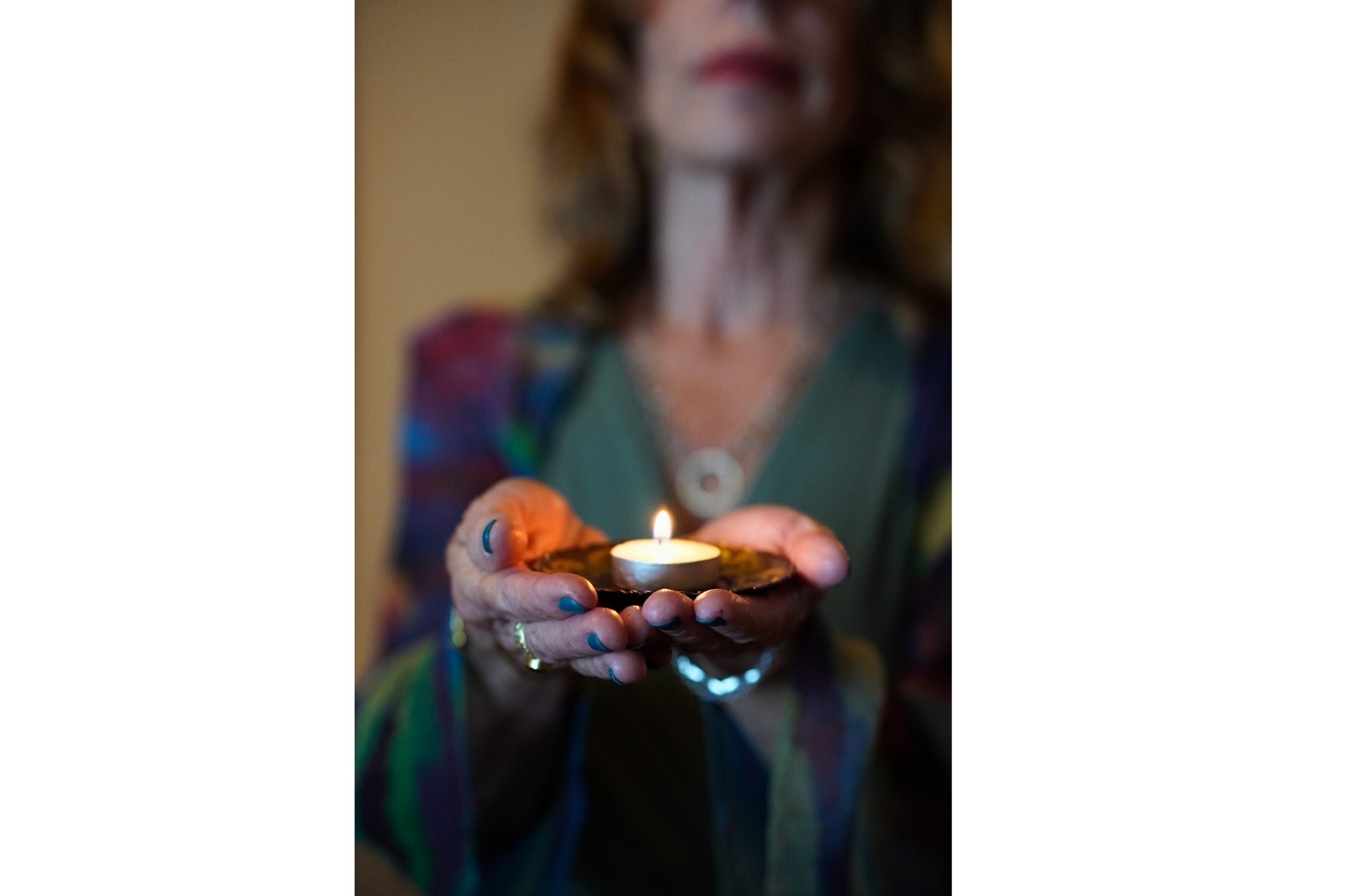
There are many ways to relocate our love. We may create or participate in ceremonies and rituals that offer us a container in which to place our most sacred feelings. We might light a candle for our loved one every day, build a shrine at an accident site, form a charitable foundation or erect an artistic memorial. This shift from the physical to the place that transcends the physical may be obvious or it may be subtle, outwardly visible or utterly private. Relocation is what lifts the burden of loss from our grounded vessel, blows the air of passionate aliveness back into our sails and allows us to move forward.
We heal and grow because of our losses, not in spite of them. We are not seduced by the illusion that we will never suffer again. We know that other losses will come. We do not presume to predict how we will handle them. But we make the choice to embrace life anyway, fully aware of its beautiful fragility. Love makes our hearts big enough to hold impossible hope.
Mirabai, thank you. This is beautiful, so timely, relevant, and healing. You are spreading so much love. Mahalo,
Thank as always for your presence in this world that breeds so much love